
Understanding The Second Arrow of Suffering
May 18, 2026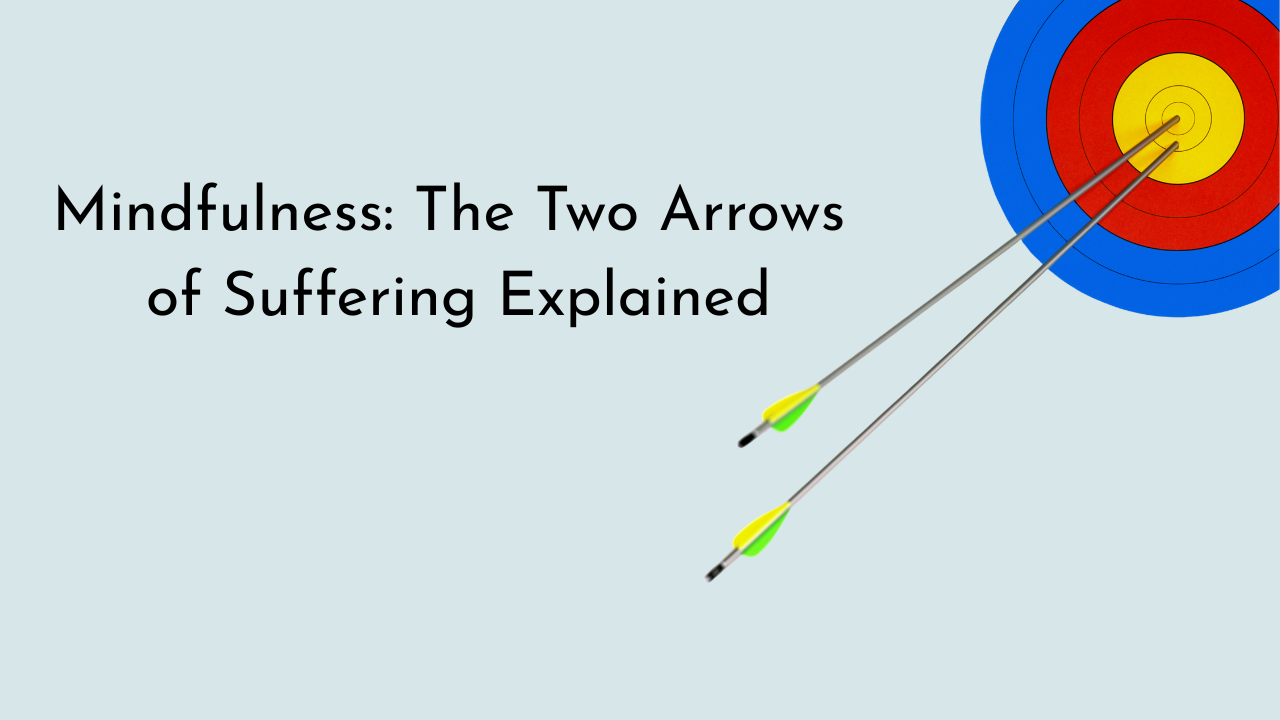
🌿 The Two Arrows of Suffering Explained
If you've ever explored mindfulness, you may have come across the idea of the "two arrows".
It's a simple but powerful way of understanding something we all experience:
why life can sometimes feel harder than the situation warrants.
In mindfulness we recognise that while we often can't control what happens, but we can learn to relate differently to it.
What are the two arrows?
Everyday life can bring unexpected challenges or uncertainty. Mindfulness describes these as the first arrow.
These are situations we don't choose and often have very little control over. It's what happens next that can become complicated.
The first arrow: what happens to us
The first arrow is our direct experience of life.
For example:
- difficult conversations
- illness or physical discomfort
- work stress or pressure
- disappointment or loss
- unexpected change
These experiences are part of being human and some levels of discomfort or difficulty are unavoidable.
The first arrow represents what is happening.
The second arrow: the suffering we add
The second arrow is our reaction to the first experience and usually where our mind goes into overdrive.
We might:
- try to mentally fix what can't be fixed
- replay the situation over and over
- imagine the worst case scenarios
- feel stuck and lose all perspective
- forget that our thoughts are just mental activity
This is often where overthinking begins - and where mindfulness can help.
This is the second arrow and often it intensifies our suffering.
Why the second arrow creates so much suffering
One reason the second arrow is so powerful is because of how closely thoughts and the body are connected. If you imagine your favourite meal, you may start to salivate. This is the mind body connection.
In exactly the same way, repeatedly thinking about a difficult situation, triggers a physical response in the body. For example:
- rumination activates the nervous system
- worrying keeps the body in a heightened state of alert
- the mind detects the threat and shifts into problem solving mode
Over time this can lead to:
- mental fatigue
- emotional exhaustion
- and a sense of overwhelm all adding to what is already a difficult experience.
How mindfulness helps soften the second arrow
Mindfulness does not remove the first arrow, it acknowledges that life can bring challenges.
Instead, mindfulness helps us to become aware of our experience as it is happening:
We learn to notice:
- the body caught up in the stress response
- our thoughts getting caught up in rumination and worry
This awareness creates our mindful pause so we can gently shift our attention away from the mental spiral and steady it on the breath.
Simple practices like focused attention training help to build this ability over time.
How mindfulness creates space between experience and reaction
With practice, something subtle begins to change and we start to notice a gap between:
what happens and how we respond
This space is created through our mindfulness practice. It's not about removing difficulty but meeting our experience with more clarity and less reactivity.
We begin to see our thoughts as thoughts and just like notifications, we do not need to respond to every one.
That recognition alone can soften the intensity of what we are experiencing.
Mindfulness is not about avoiding pain
Mindfulness is often associated with calm and relaxation, but it is not about avoiding difficulty or trying to eliminate pain.
Life will always contain both ease and challenge.
Instead mindfulness helps us to:
- become aware of our automatic reactions
- notice when we are escalating our own suffering
- and gently return to a more grounded way of relating to experience.
It's not about controlling life. It's about meeting life more clearly.
Final thoughts
We may not have control over the first arrow, but we can learn to recognise and soften the second.
Through awareness, we begin to meet our experience with more space, less reactivity and greater understanding.
Over time, this does not remove difficulty from life - but it can change how we experience it.
And sometimes that changes everything.
Explore mindfulness support tools with Just Breathe
Ready to find out how mindfulness can support you? Download our FREE mindfulness guide for overthinking and emotional overwhelm.
Pause, Breathe and Claim Your 10% Gift
Subscribe today to be the first to hear about retreats and get 10% off events designed to help women reclaim their calm, clarity and authenticity.
We respect your privacy — no spam, just inspiration and early access.
