Workplace Stress Management:
Are We Getting It Right?
At a time when workplace investment in wellbeing is at its highest, we are left wondering how that return on investment is actually playing out. Organisations have invested heavily in workplace wellbeing, from wellbeing days and Employee Assistance Programmes to apps and mental health support. Yet stress, burnout and stress-related absence remain significant challenges.
According to Deloitte's 2024 research poor mental health costs UK employers nearly £51 billion each year, with presenteeism accounting for almost half of that figure at around £24 billion.
Presenteeism is particularly difficult to address when stress is involved. Employees may still be at work and still performing, while struggling in ways that aren't immediately visible. Understandably, many workplace interventions are therefore targeted at people who are already struggling significantly or have reached burnout.
At the other end of the spectrum, broader well being initiatives may encourage employees to look after themselves, exercise, sleep well or manage their work life-balance.
We believe there's an important space between the two.
A point at which stress is beginning to take its toll, but the employee is still functioning and may not yet have awareness or a clear route to support.
£51 billion - the estimated cost of poor mental health to UK employers
£24 billion - the estimated cost attributed to presenteeism.
Deloitte 2024
Help Employees Interrupt Stress Before It Becomes
the Background to Their Working Day
The challenge is that prolonged stress isn't always visible. Employees may still be at work. Still performing. Still getting through the day. But carrying the stress of one situation into the next.
These are the employees who may look OK on the outside but are struggling on the inside.
A difficult meeting ends. A deadline passes. An uncomfortable conversation is over. But for them, the mind doesn't always move along with the diary.
One of the significant aspects of stress is this tendency towards continuous problem-solving, replaying and worrying. And it isn't always as simple as deciding to switch off. These patterns can keep the body's stress system activated long after the original situation has passed.
This is where Just Breathe provides a different kind of support: practical, evidence-informed tools that help employees understand what's happening, recognise their own patterns earlier and learn how to interrupt prolonged patterns of stress.
Register for Our Workplace Stress Report
What Happens
After the Stressful Moment Has Passed?
We all encounter stressful situations, but sometimes they linger longer than they should.
The stressful event may be over long before our reaction to it is.
It's human nature -
- We replay conversations.
- Anticipate what might happen next.
- Rehearse what we should have said.
- Carry work home.
- Wake during the night thinking about tomorrow.
Over time, if we're repeatedly caught in these patterns, it can affect concentration, sleep, emotional regulation and our ability to switch off and reclaim capacity.
And because employees can continue working while this is happening, the impact isn't always immediately visible.
This is the space in which Stress Interruption operates.
What if Employees Could
Interrupt the Cycle Earlier?
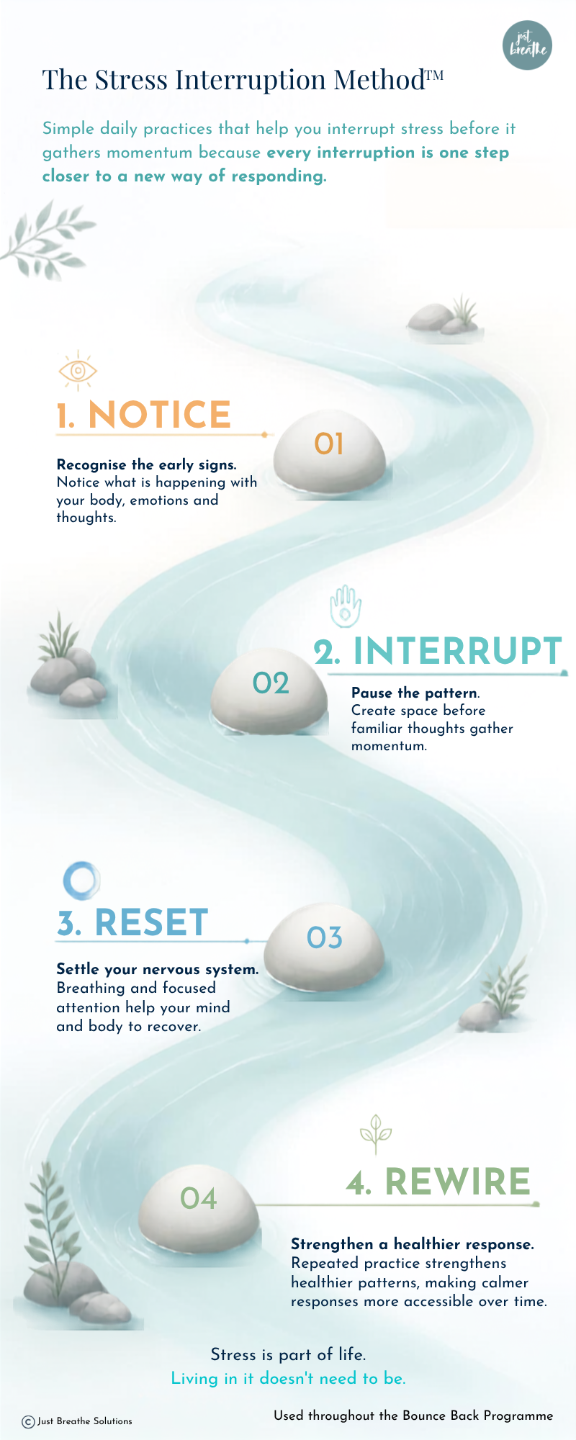
The Stress Interruption Method teaches a simple framework:
NOTICE → INTERRUPT → RESET → REWIRE
NOTICE
Recognise the thoughts, emotions, physical sensations and habitual patterns that can keep stress going.
INTERRUPT
Learn practical ways to disengage from unhelpful mental loops before they gather momentum.
RESET
Use focused attention, mindfulness and short guided practices to help settle the mind and body and regain capacity.
REWIRE
Through repeated practice, develop greater awareness of habitual patterns and alternative ways of relating to stressful situations.
The objective isn't to create a stress-free workplace.
Stress is a natural part of working life.
The opportunity is to help people become better equipped to recognise when a natural stress reaction is continuing long after the immediate situation has passed.
Developed Through Research.
Designed for Real Working Lives.
The Stress Interruption Method was developed by Julie Perrigo, following a 30-year career in technology and postgraduate study and research in mindfulness at the University of Aberdeen.
The original 21-day digital programme formed part of Julie's MSc research into whether a structured online intervention could help people change their relationship with stress.
In that research, 80% of participants reported experiencing benefit from the programme.
Those findings became the foundation for Bounce Back: a practical programme combining education, mindfulness, focused attention and guided experiential practice.
Explore the Science Behind Stress Interruption

Julie Perrigo
Founder, Just Breathe Solutions
Creator of the Stress Interruption Method™
MSc Mindfulness
30 years' corporate technology experience
One Framework.
Flexible Workplace Support.
Organisations can introduce Stress Interruption as an experiential 21-day intervention that aims to change the relationship with stress. Combine this with the Just Breathe app, to get daily support too.
Bounce Back: 21-Day Stress Interruption Programme
This 21 day intervention is designed to help employees understand how stress works and recognise the patterns that can keep it going.
Sessions of 30 minutes per day combine educational content with guided experiential practice.
Employees learn about stress, attention, thoughts, emotions and habitual reactions while developing practical techniques they can continue using after the programme ends.
Just Breathe Workplace App
Ongoing, on-demand support designed to fit around working life.
Employees can access short stress-interruption practices alongside guided mindfulness, morning practices, sleep support and educational content.
With practices starting from just three minutes, these are available as practical interventions between meetings, during coffee breaks or whenever somebody notices that their mind is replaying difficult situations.
Bounce Back + Just Breathe
For organisations looking for both structured learning and ongoing support, the 21-day intervention can be combined with the app.
Employees start with the principles and techniques behind Stress Interruption and then retain practical resources that can help them continue applying what they have learned.
Your Workplace Stress Management Options at a Glance
- 21 day intervention
- Learn how to interrupt stress
- 30 mins each day
- Structured intervention
- Year round support
- Daily reminders
- From 3 minutes
- Ongoing wellbeing
- Intervention + Ongoing support
- Learn, then continue
- Complete pathway
- Most comprehensive support
Simple to Introduce. Easy to Scale.
The programmes are delivered digitally, allowing organisations to provide access without coordinating rooms, trainers or employee schedules.
Your organisation
↓
Chooses the number of employee licences
↓
Employees receive private digital access
↓
Bounce Back | Just Breathe Workplace App | Both
↓
Employees access support when and where they need it
↓
HR receives agreed aggregate engagement information
Licences can be provided for small teams or larger workforce populations, allowing organisations to start with a pilot and expand if the approach proves useful.
Privacy and Confidentiality Matter
Privacy matters. When it comes to employee trust and engagement, concerns about confidentiality can become a significant barrier to participation.
Confidentiality is at the heart of our program, with employees accessing an external platform where they can take part in assessments, follow programs at their own pace, independently and privately.
Just Breathe is hosted independently from the employer's internal systems, helping create separation between an individual's wellbeing activity and their organisation.
Employees access their support privately.
Where organisational reporting is provided, this will can track aggregate engagement information rather than individual activity.
Workplace Stress Support Employees Can Use During the Working Day
Stress support doesn't have to mean another hour in the diary. An employee might have:
- Three minutes before their next meeting.
- Ten minutes at lunchtime.
- Twenty minutes before bed or
- They may be ready to explore why some situations repeatedly trigger the same reactions.
Just Breathe combines short interventions for the moments when people need immediate support but deeper experiential knowledge is embedded to develop awareness over time. An awareness that can alter not just an immediate reaction, but long term behaviour.
Employees can engage at a level appropriate to what they need that day, helping them settle, refocus and reclaim capacity.
A Different Approach to Workplace Wellbeing
This isn't intended to replace good management, appropriate workloads, occupational health, Employee Assistance Programmes or professional mental-health support.
And it doesn't place responsibility for organisational stress entirely on the individual.
Instead, it addresses one part of the picture that can sometimes be overlooked:
helping people understand their own stress patterns and giving them practical skills they can use when those patterns appear.
Because organisations can work to reduce unnecessary sources of stress while also helping employees become more aware of what happens when stress inevitably occurs.
Explore Stress Interruption for Your Organisation
Every organisation is different.
You may want to provide year-round wellbeing support, run Bounce Back with a particular team, introduce Stress Interruption as part of an existing wellbeing strategy, or begin with a small pilot before considering a wider rollout.
We can help you identify the most appropriate starting point.
Register your interest below and choose whether you'd like a conversation about your organisation, a copy of our forthcoming Workplace Stress Report, or both.
The Workplace Stress Report will be available by the end of October 2026. We'll send registered readers a copy as soon as it's published.
Register Your Interest
Queries are responded to within 48 hours.
Trusted to Deliver Workplace Wellbeing
Julie has delivered stress-management and mindfulness workshops for employees from organisations including: