
Why Stress Lasts Longer Than it Needs To
Aug 07, 2026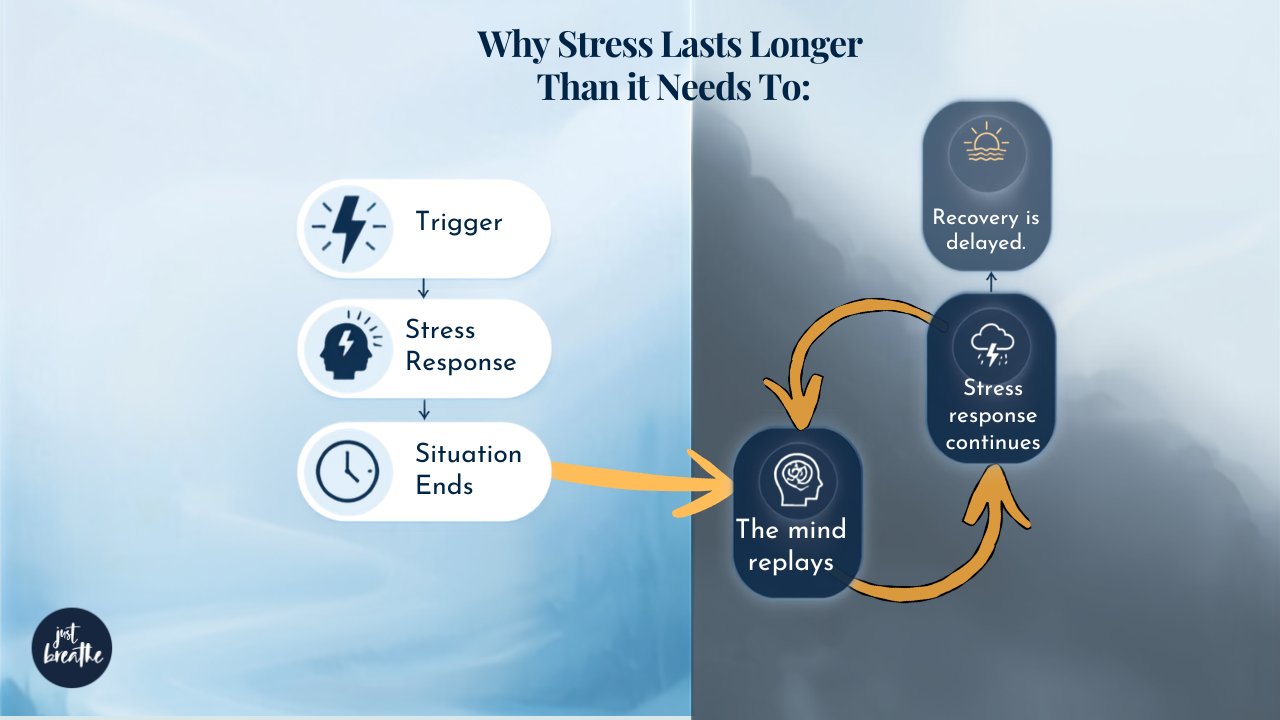
Just another ordinary day......
The meeting ends, you close your laptop, drive home and finally sit down to relax.
And then...
That conversation starts all over again.
- You replay what was said.
- Wonder what they really meant.
- Think of all the things you wish you'd said instead.
Before long you're imagining tomorrow's conversation too.
By the time bedtime arrives, you've attended the same meeting twenty times.
"It's the very nature of life that this too will end."
Eventually, every stressful situation passes.
- The difficult conversation finishes.
- The medical appointment is over.
- The deadline is met.
- The email has been sent.
This is our time to sigh it all out and relax.
But often the mind has other ideas.
It just doesn't seem ready to let go. Instead it quietly drifts between....
- what has already happened,
- what might happen next,
- and questions that don't really need answering.
Like a film movie playing on repeat, we seem to take home something that we left in the office hours ago.
And we accept this because it feels normal. It feels like problem solving and over time it becomes more and more familiar to us.
But there is a hidden cost.
What we often don't realise is that every time our mind relives that difficult event, the body experiences the same sense of threat.
That observation is increasing supported by what neuroscience tells us about the relationship between our thoughts, our brain and our stress response.
Slowly these patterns become normal until a sense of exhaustion appears to creep up on us from nowhere.
It's not that life suddenly became harder. We've just spent so much time mentally living it twice.
Often changing our external world seems like the obvious answer.
We leave the stressful job or avoid difficult people.
Life slows down and initially we experience some relief. But here's what fascinated me.
Even when life became calmer, the mind didn't necessarily stop worrying.
In fact, it just found something new to worry about.
Compared with everything that had gone before, these worries often seemed trivial.
But for the body.....
the outcome was surprisingly similar.
For the body, that sense of threat just continued.
That realisation became deeply personal for me. It led me to two questions:
- Were these persistent thoughts actually wearing me out?
- Or was it just me? How did everyone else seem to cope when I couldn't?
Then something profound happened that completely changed how I thought about stress.
During a mindfulness practice...
For perhaps twenty or thirty seconds...
my mind became completely still.
A few moments of stillness.
I often describe it as watching a great watermill slowly stop turning.
The peace was so unfamiliar that I remember feeling almost frightened about my next thought. I sensed that one single thought would start the entire machine up again.
That experience fascinated me because it made me question everything I thought I knew about stress.
And experiencing that stillness led me to different questions:
- What if pursuing a stress free life wasn't realistic? - After all, stress is part of being human.
- What if the true gift was spending less time living in it.
- Could we learn to let stressful events come to a natural end, without the mind prolonging them?
The more I researched mindfulness, neuroscience and stress recovery, the clearer it became that many of us aren't living inside the original stressful event.
We're living inside the thoughts that continue long after it has passed.
Exploring those questions became the foundation of my MSc research and later the development of the Bounce Back Programme, where I explored whether people could learn to recognise these patterns earlier and interrupt them before stress became their default way of living.
The other question..... was it just me?
I found the answer to that too because the more I worked with people the more I heard the same familiar stories....
Very few people tell me they feel stressed, but they do say..
- "I can't switch off."
- "I'm exhausted."
- "I'm overthinking everything."
- "I don't feel like myself anymore."
They often think they're looking for moments of calm.
What they've actually lost is something much deeper.
Their capacity for life.
Their capacity to enjoy the life that's in front of them.
We begin to reclaim our capacity when we notice the moment our minds keep stress alive—and gently interrupt the patterns that prolong it.
Not because life suddenly becomes easier.
But because we stop asking our minds and bodies to keep reliving what has already ended.
After all...
Stress may be part of life - living in it doesn't need to be.
About the author
Julie Perrigo MSc is a Stress and Emotional Awareness Specialist, mindfulness teacher and creator of the Stress Interruption Method.
She holds an MSc in Mindfulness from the University of Aberdeen, where her postgraduate research explored the use of a structured digital mindfulness programme to support stress and emotional wellbeing. Julie combines her research and teaching experience with more than 25 years working in corporate environments.
She is also the author of The Emotional Hustle and founder of Just Breathe Solutions, where her work focuses on helping people understand the patterns that can keep stress going and develop practical skills to interrupt them.
Pause, Breathe and Claim Your 10% Gift
Subscribe today to be the first to hear about retreats and get 10% off events designed to help women reclaim their calm, clarity and authenticity.
We respect your privacy — no spam, just inspiration and early access.
